
The Economy as the Backbone of Society
Economy is far more than numbers on a spreadsheet or the rise and fall of markets. It is the invisible framework that shapes how societies grow, how communities form, and how human beings relate to one another and to the natural world around them. Throughout history, the strength or weakness of an economy has directly determined the quality of life of entire civilizations, from the flourishing of ancient Mesopotamia along the fertile banks of rivers like the Dez, to the industrial revolutions that transformed Europe and North America, to the rapid urbanization we witness across the globe today.
When an economy grows in a healthy, equitable manner, it creates opportunities for education, for innovation, for cultural expression, and for architectural ambition. Cities rise. Public spaces are created. Infrastructure is built to last generations. Conversely, when economic systems falter or distribute their benefits unequally, the built environment reflects that imbalance: neglected neighborhoods, decaying infrastructure, and communities cut off from the resources they need to thrive.
Understanding economy, therefore, is not merely the domain of politicians or financial analysts. It is essential knowledge for architects, engineers, urban planners, and anyone who shapes the physical world we inhabit.
The Linear Economy and Its Social Consequences
For the past two centuries, the dominant economic model has been what we now call the linear economy, a system built on a simple and ultimately destructive sequence: Take, Make, Dispose. Raw materials are extracted from the earth, manufactured into products, consumed, and then discarded as waste. This model fueled the industrial revolution and enabled unprecedented economic growth, but at an enormous cost that we are only now beginning to fully understand.
The social consequences of the linear economy are profound and wide-reaching:
- Environmental Degradation: The relentless extraction of natural resources has depleted forests, polluted rivers, and accelerated climate change.
- Inequality and Social Fragmentation: The linear economy concentrates wealth among those who control resources, while externalizing costs onto workers and communities.
- Planned Obsolescence: Products are deliberately designed to have short lifespans, a culture of disposability that has extended to buildings and cities.
- Resource Scarcity and Conflict: As finite resources become scarcer, competition intensifies between nations, corporations, and communities.
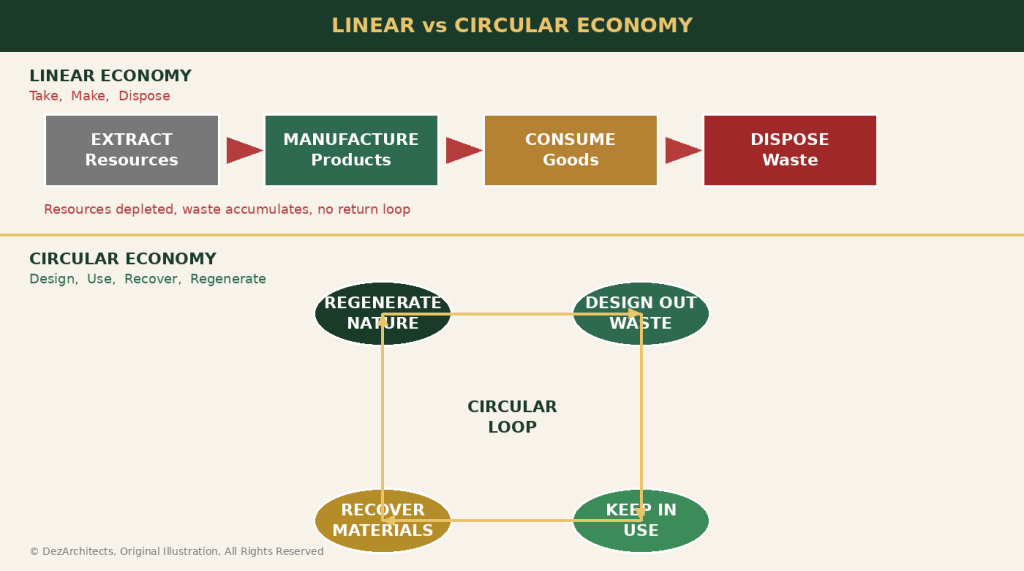
Figure 1: Linear vs Circular Economy, the fundamental shift from Take, Make, Dispose to a closed-loop regenerative model. (Original illustration © DezArchitects)
Circular Economy: A Vision for Sustainable Futures
The Circular Economy represents a fundamental rethinking of how we produce, consume, and relate to the material world. Rather than the linear Take, Make, Dispose sequence, the circular model is guided by three core principles:
1. Design Out Waste and Pollution
In a circular economy, waste is not an inevitable byproduct, it is a design failure. Products, systems, and buildings are designed from the outset to minimize waste, eliminate toxic materials, and enable the reuse or recovery of all components at the end of their useful life.
2. Keep Products and Materials in Use
Materials and products are kept in circulation for as long as possible through strategies of reuse, repair, remanufacturing, and recycling. Value is preserved rather than destroyed, shifting our relationship with the built environment from ownership and disposal to stewardship and care.
3. Regenerate Natural Systems
Rather than depleting natural capital, a circular economy actively seeks to restore and regenerate ecosystems, returning biological materials to natural cycles, reducing carbon emissions, and designing human systems that work in harmony with the natural world.
Circular Architecture: Building for Perpetual Value
When the principles of the circular economy are applied to the built environment, they give rise to Circular Architecture, a design philosophy that treats buildings not as disposable products but as long-term repositories of material, cultural, and social value.
- Design for Disassembly: Buildings are designed so their components can be easily separated and recovered at end of life, re-entering the production cycle as valuable resources.
- Material Passports: Every material is documented, what it is, where it came from, and how it can be reused, transforming buildings into urban mines for future generations.
- Adaptive Reuse: Circular Architecture strongly favors the transformation of existing buildings over demolition, preserving embodied energy and cultural memory.
- Long-life, Loose-fit Design: Buildings are designed to be flexible and adaptable, capable of accommodating different uses over time without requiring demolition.
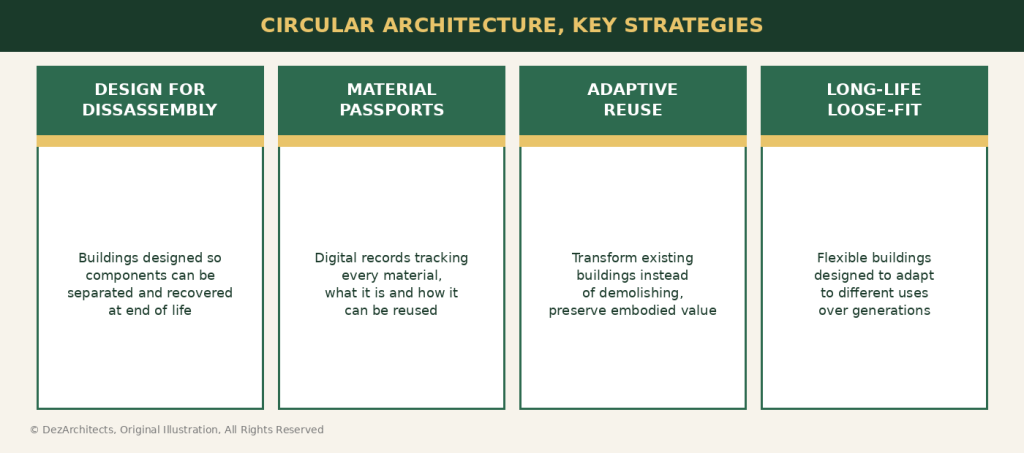
Figure 2: Key strategies of Circular Architecture, from design for disassembly to long-life loose-fit design. (Original illustration © DezArchitects)
Circular Architecture in Practice: Global Pioneering Examples
Several pioneering buildings worldwide serve as material banks, designed specifically to be taken apart and reused rather than demolished. These structures directly implement circular economy principles through modularity and material tracking. The following examples demonstrate how these ideas have moved from theory into built reality.
Triodos Bank Headquarters, The Netherlands
Located on the De Reehorst Estate, the Triodos Bank Headquarters is considered the world’s first large-scale, 100% wooden, fully reconstructible office building.
- Circular Design: The building is held together by 165,312 screws, allowing it to be completely disassembled without losing any material value.
- Material Passport: Every single component is documented in a digital material bank, facilitating future reuse of the entire structure.
Brummen Town Hall, The Netherlands
Designed by RAU Architects with a fixed 20-year service life in mind, due to potential municipal boundary changes.
- Lego-like Structure: Approximately 90% of the materials in the new addition can be dismantled and reused without loss of value.
- Value Retention: The design guarantees that materials will retain at least 20% of their residual value at the end of the building’s life.
The People’s Pavilion, The Netherlands
Created for Dutch Design Week in Eindhoven, this structure was built entirely from borrowed materials, demonstrating the purest form of circular thinking.
- Zero Waste: No glue, screws, or drills were used on the borrowed components, including wooden beams and plastic shingles, ensuring they could be returned to their owners in original condition after the event.
Circle House, Denmark
A scalable demonstration project for circular social housing, showing that circularity can work at a residential scale.
- Standardized Parts: Built using only six demountable piece types, two wall elements, two beam lengths, and two deck lengths, making the entire structure easy to deconstruct and reassemble elsewhere.
Building K.118, Switzerland
A high-profile example of upcycling at an architectural scale, located in Winterthur.
- Reclaimed Materials: This office building is composed mostly of recycled materials, including steel components salvaged from demolished structures and windows from a former office building.
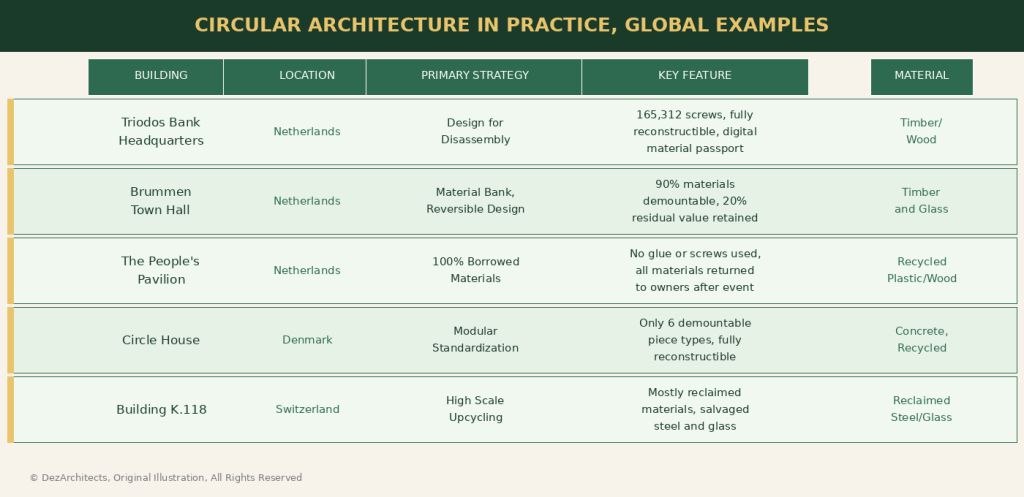
Figure 3: Global examples of Circular Architecture, key buildings demonstrating material reuse, disassembly design, and circular strategies in practice. (Original illustration © DezArchitects)
The Common Ground: Circular, Sustainable, and Green Architecture
Circular Architecture shares deep philosophical and practical common ground with Sustainable Architecture and Green Architecture. Together they rest on five shared pillars:
Pillar 1: Responsibility to Future Generations
All three approaches are rooted in an intergenerational ethic, the recognition that decisions made today about buildings, cities, and materials will shape the world inherited by those who come after us.
Pillar 2: Minimizing Environmental Impact
Whether through energy efficiency, reduced resource consumption, or holistic environmental planning, all three approaches seek to reduce the negative footprint of the built environment on the natural world.
Pillar 3: Systems Thinking
Each approach rejects the idea that a building can be understood in isolation. A building is part of an energy system, a material system, a social system, and an ecological system, and designing well means working with these interconnections.
Pillar 4: Local Context and Culture
All three movements emphasize designing in response to local climate, materials, culture, and community needs. Buildings rooted in their context use fewer resources, serve their communities better, and endure longer.
Pillar 5: Innovation in Service of Longevity
All three movements embrace technological innovation in materials, construction methods, and energy systems, but always in service of buildings and communities that will last and serve human and ecological wellbeing over the long term.
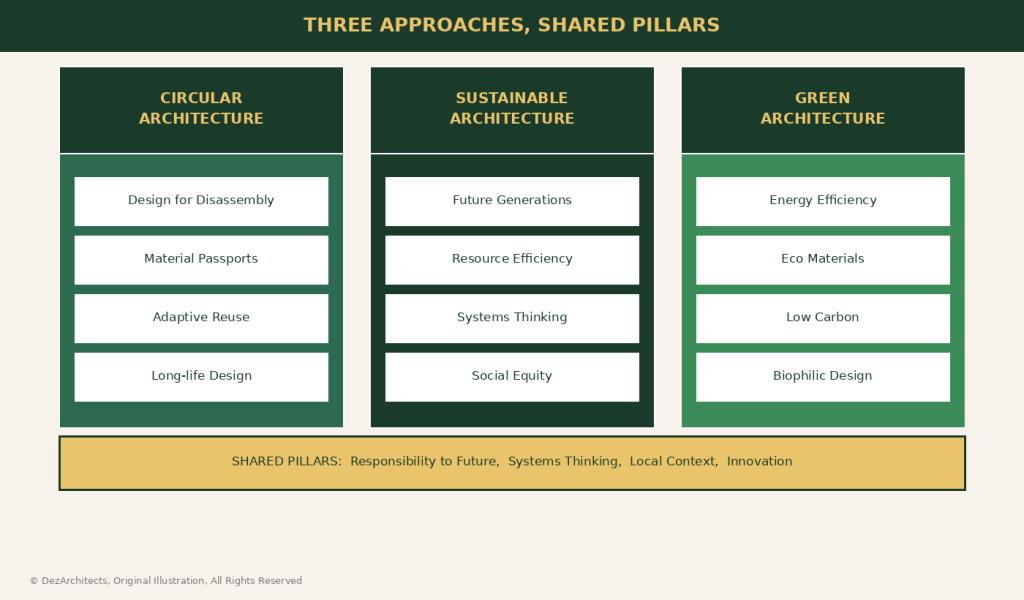
Figure 4: Three architectural approaches and their shared pillars, Circular, Sustainable, and Green Architecture converging on a common vision. (Original illustration © DezArchitects)
Conclusion: Architecture at the Turning Point
We stand at a turning point in the history of human civilization. The linear economic model that built the modern world is reaching its ecological and social limits. The question now is whether we can imagine and build a different kind of future, one in which the economy serves human flourishing, and in which the built environment is a regenerative force rather than a destructive one.
Circular Economy gives us the economic framework. Circular Architecture gives us the design language. Sustainable and Green Architecture give us the accumulated wisdom of decades of practice and research. Together, they point toward a built environment that is not only beautiful and functional, but genuinely worthy of the civilizations that create it, and the generations that will inherit it.
The pioneering buildings featured in this post, from the Triodos Bank in the Netherlands to Circle House in Denmark, show us that this vision is not utopian. It is already being built.
At DezArchitects, this vision is not abstract. It is the lens through which we understand every project, every material choice, every design decision. The rivers that nourished the world’s first civilizations still flow. The question is what kind of world we choose to build along their banks.
DezArchitects | Architecture, Green Engineering & Environment | dezarchitects.com